Thursday, December 13, 2012

Church Music


J.S. Bach got in trouble in the 1700s for showing an unchaperoned young lady the pipe organ in the choir loft. I didn’t get in trouble when a young church organist showed me the Allen organ in the choir loft Tuesday evening, but I did get a bit winded from climbing three flights of stairs.
            Nicodemus and I, finding ourselves without a Christmas gig for the first time in memory, volunteered to play for caroling at our church in San Francisco.
            Music at Holy Trinity Greek Orthodox is almost exclusively Byzantine chant, as it is in almost all Orthodox churches. A number of Russian composers have made beautiful settings of the liturgy’s 11th-century words, but church choirs find the music daunting and mostly stick to the ancient modal chants. Some Orthodox churches still use the primitive notation called neumes, music writing which looks a little like some kind of pasta.
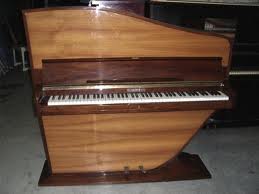
            The choir accompanist is the only organist we hear at church, so I met the wedding organist for the first time when he came over while we were playing to see if there was a way to open up the little Rippen piano to get more sound (there wasn’t.)
            After the carols and the treats—you can imagine the spread a Greek church calls snacks--we got to talking about organs and the young man, George, said he had selected the instrumental sounds for the church’s organ, an Allen, when it was being built. Organists usually sound a little apologetic when they speak of electronic organs (as opposed to pipe organs,) though the serious electric ones have a wonderful sound and don’t depend on hard-to-find pipe repairmen.
            “Would you like to see it?” he asked.
            “Oh, yes,” I said. I have never been in the choir loft, which has its own beautiful mosaics of Saint Kassiani and other hymn composers.
            “Oh, it’s just like the one our local orchestra used for the Saint-Saëns organ concerto a little while back,” I said, still a little out of breath.
            “Oh, wow,” the organist said, and immediately launched into the famous theme on full organ with every pedal stop depressed, hands and feet moving happily, drowning out the taped chanting which goes on downstairs all the time and probably terrifying a few sleeping pigeons on the roof.
            “Oh, my goodness,” I said,  overwhelmed. Saint-Saëns was a universe—and ten centuries—away from the five-note Kyrie Eleisons we usually hear in church.
            “What does your trumpet sound like?” I asked.
            He whipped out a computer card, did some sleight-of-hand, and played the Jeremiah Clarke Trumpet Voluntary, full organ, pedals. I reached over his right hand and joined the fun up on the high notes.
             I got all the way home before I remembered that there’s a closed circuit TV camera on all the time at church so that people can look at their computers to see the mosaics and listen to the chanting if they need a quiet moment. I do it myself from time to time when I can’t sleep.
            If anybody was watching Tuesday evening, they wouldn’t have seen anything different, but they would have heard a lot of organ music which was anything but Byzantine.

Tuesday, May 1, 2012

The Music Mystique


 I have been searching in vain for a music theory book which would be good for a couple of bright young instrumentalists who want to know more about the architecture of music but who don't yet need college-level theory and harmony. The next several blogs are what resulted. We had to write our own book, the kids and I. It is called

The Music Mystique
Basic Music Theory


Did you know that musical rhythm is based on your own heartbeat and breathing rate? Or that the scale, the basic building block of music, is actually based on the physics of sound? Did you know that every human being has these musical elements built in, and that this fact can be proven? That some people believe the Big Bang which started the universe was actually a dissonant chord? That everything in creation from the atom to Jupiter vibrates and thus has a sound?
The Nineteenth Century composer Robert Schumann called music a bridge to the unknown. Music theory shows the construction of that bridge. Because it encompasses history, anthropology, physics, mathematics and languages, knowing something about music theory reinforces all these other fields. Understanding basic theory, you can learn the rudiments of reading music in less than an hour, can play three chords and a melody...all it takes for some folks to be country music performers or rock stars!           
There are hundreds of music theory books in print, many of them college-level books which include music history and advanced analysis. There is a Music Theory for Dummies which, despite its unfortunate title, may tell you more than you really wanted to know about music theory. The theory books which accompany instrumental method series mostly refer to applied theory.
You probably already know a lot of music theory intuitively, since you have been listening to music all your life. My primary goal in teaching music theory is to provide a vocabulary and to demonstrate the elegance of  the traditional customs which lie behind the music you know and love. This little book is intended for the music student who has played an instrument for several years and is interested in learning more about the order behind the music he or she is playing.
There are several good on-line sources for basic theory information: Music Theory Pro, an application for iPhone and iPad, lets you test yourself in various areas of theory. An invaluable web site, updated daily, which tells you everything you wanted to know about music theory is found at http://www.teoria.com/index.php.
The neuroscientist Daniel J. Levin is among those who have used magnetic imaging to show the positive way music affects the brain. In his book This Is Your Brain On Music, Levin says “By better understanding what music is and where it comes from,, we may be able to better understand our motives, fears, desires, memories, and even communication in the broadest sense.” The neurologist and music lover Oliver Sacks’ book Musicophilia says that all people are hard-wired to love music and that the ability to sing or play an instrument creates positive physical changes which last a lifetime.

Friday, February 10, 2012

Music Guilt


Do my old piano students hide when they see me coming down the street? I am convinced that they do. Why else would I live in a community of 30,000 and hardly ever see one of the thousands who have sat at my piano and said “I played it better at home”?

When I made my excuses for not practicing enough, my piano teacher would say “I’m so sorry” and then give me an unforgettable lesson on some aspect of my assignment which did not involve much playing on my part.

At some point in my 50-year teaching career, I got the idea of the graceful exit. I had already made myself the student’s ally in situations where clearly it was time for the lessons to end.

“Pleasing your parents is a legitimate reason to take some lessons, but I can see you aren’t enjoying it very much.”

“Would you like me to get you out of this?”

“We can still be friends. You can come to see me without having to play piano.”

“You have accomplished quite a lot during this time, so you should feel good about that rather than feeling bad that we’re stopping here.”

On one occasion, I presented a teen-ager who was quitting lessons with a certificate of accomplishment, a prize ribbon and pin, a list of her repertoire, and suggestions for pieces she might enjoy playing on her own. I never heard from her or saw her or her parents again, though they live in my neighborhood.

Piano teachers become attached to their students, and occasionally the attachment goes both ways. I am still in touch with a few of my former students. But for the most part, once they quit lessons, they are gone. I have only discontinued lessons a few times without being asked to do so by parents or students, once because of persistent rudeness and the other times because of persistent absenteeism. So I think I am dealing with music guilt most of the time.

Of course they should have practiced more, and so should I. I hate to think what my poor mother went through to get me to practice. The final incentive was the threat to end the lessons if I didn’t practice, and that one always got me to the piano. I am not a very good example when it comes to practice, but if I total up all the hours I have spent at the piano, it certainly would surpass the 10,000 hours the experts now say it takes to really learn a skill. (Notice that I do not say “master” a skill.)

I left my teacher only when he moved to a rest home which had no piano. At my last lesson, he couldn’t even remember my name, but he remembered that we were fond of each other, and he remembered all the page turns in the Chopin Scherzo I was studying. He got up from his chair across the room and turned the pages for me.

It is possible that my students’ lessons were not all that important to them, that they were just one more activity, that they were like a sixth grade English class or something, where you would go on your way and never feel the need to stay in touch. But piano lessons are one-to-one, not one-to-thirty. Piano teachers and their students know a lot about each other. They might still have something to say to each other even after the lessons are over.

(The Seal of Approval, above, appears on all my students' assignment sheets.)

Saturday, October 15, 2011

The X-Factor and American Idol


I have been watching a singing competition called X-Factor on television. This is not my kind of music (if indeed it is music at all), but I want to know what people are listening to, and the audience for this show has been estimated at some 12 million people.

The X-Factor supposedly was judge Simon Cowell’s nose-thumbing to the runaway success American Idol. The similarities between the two shows are more remarkable than the differences (Pepsi vs. Coke), and they do not compete against each other, since Idol does not resume until January, 2012. Thousands of youngish men and women, most of them delusional, audition from every part of the country. Each one whose face makes it to television says “This is my dream” and “I want this so much” and “I’ve been singing since I was three years old.” Often they cry and tell something sad about their life.

A few of these thousands are chosen and perform pop songs in front of four judges. Idol has an audience and a band; X-Factor does not, at least not yet, and it uses recorded accompaniments instead of live musicians, though there are grand pianos sitting around for atmosphere.

The top prize in X-Factor is five million dollars and a recording contract. One contestant, filmed on the grounds of a judge’s Malibu estate, said “If I win the five million dollars, I’m going to buy a house like this.” Beachfront Malibu property goes for sums in the forty millions, and this young man is not going to win because he doesn’t fit the image which appeals to the target audience.

Target audiences for recordings are age 14 to 24, for radio 15-30. The 40-year-old African-American with the stunning vocal ornaments may make it into the finals, but she will not win.

To win, here’s what you need: A commercially viable appearance and sound, the right combination of conformity and individuality. True, you should try to sing in tune, but more importantly, you should be cute and confident. People of color rarely win American Idol, nor do homosexuals (Adam should have won.) I have yet to see an Asian contestant, though I may have missed something; I can only stand so much.

Finalists do get some advertising work, and some Idol winners have gone on to have recording careers. I would like to think that the also-rans get royalties, but I’d be willing to bet that they signed away this right when they auditioned.

Idol/X Factor music is generally aimed at an audience older than the pre-teens who launched Spice Girls and Justin Bieber to fame. Some of the music, however, still fits the Wiki definition of Bubblegum, being “ pop music... produced in an assembly-line process, driven by producers, often using unknown singers...” “The songs typically have singalong choruses, seemingly childlike themes and a contrived innocence, occasionally combined with an undercurrent of sexual double entendre. Bubblegum songs are also defined as having a catchy melody, simple chords, simple harmonies, dancy (but not necessarily danceable) beats, repetitive riffs or “hooks”, use of solfege syllables and a vocally-multiplied refrain.”

I wish Coke and Pepsi would set up an education program for all these thousands of people who have been singing since they were three, or else contribute substantially to existing programs. I wish they would send lots of money to Gustavo Dudamel, the young conductor of the Los Angeles Philharmonic, who is launching a wonderful music education program similar to the one in which he studied in Venezuela. Gustavo has probably been singing since he was three, he’s cute, he’s smart, and by golly, he can even read music. He makes a base salary of a million and a quarter a year, recording contracts, I don’t know what all. Importantly, he will still be doing his job when nobody remembers American Idol or X-Factor.

Meanwhile, here is some advice for Idol/X-Factor contestants: If Simon mentions phrasing, try to find out what that means. Do not scream. Do not perform your original song, because it isn’t any good and nobody wants to hear it. “Make it your own” does not mean distorting the song beyond all recognition. Songs have composers. Please use the name of the composer rather than that of the performer when you say what you’re singing. If you have religious views, keep them to yourself. This is the Temple of Mammon, after all. Try to keep a vestige of dignity. Sing TO the judges, not AT them.

Sunday, May 15, 2011

Natural Music

We believe music came from nature, that the rhythms and melodies we love had their origins in the sounds around and within us. But sometimes the natural world seems to join in rather than initiate our music-making.

Animals who live in a musical house will usually vote one way or the other. More than one cat has taken a liking to Mozart or has left the room when the atonal music began. Old dogs which are becoming hard of hearing sometimes like to sleep under a grand piano, where they can hear the sound, but not too loudly.

Once Charles and I were playing a Shostakovich cello sonata at a senior residence facility. The first movement was whimsical and playful, but the middle movement was as stark and cold as I imagine a Russian winter--or being old-- might sometimes be. As we played, the wind whistled around the edges of the building like a third musician. The audience clearly welcomed the return to cheerfulness in the last movement, and so did we.

Once while I was playing the organ at church, I became aware of a small sound which started up as soon as I began playing and stopped when I stopped. It took a while to realize that the sound was coming from a frog which had parked itself in the doorway near the organ. He sang along for quite a long time.

Today at the Coastside Community Orchestra concert, there seemed to be a strange piccolo part in Schubert's incidental music from Rosamunde. It was a kind of counterpoint, and, for goodness' sake, it was coming from outside the window. It was a songbird who apparently liked Schubert.

Monday, January 24, 2011

The Times Critic's Top Ten

Anthony Tommasini, music critic for the New York Times, published his picks for the top ten composers (excluding living composers) of all times.
1. Bach
2. Beethoven
3. Mozart
4. Schubert
5. Debussy
6. Stravinsky
7. Brahms
8. Verdi
9. Wagner
10. Bartok

But where is Haydn? Handel? Dvorak? I'm afraid the last three--maybe even the last four--wouldn't have made my list.

Friday, January 14, 2011

Some Constellation

“Classical” music, strictly speaking, is music written between 1750, the date of J.S. Bach’s death, and the end of the eighteenth century, when Beethoven walked through the front door of the palace and ushered in the Romantic period of music.

Bue “classical” has become a catch-all term for music which doesn’t easily fall into other categories. People have tried calling it art music, un-popular music, longhair. It’s a bit like the word “germ” for a doctor, who will want to know what kind of germ we are talking about. Or “baby grand” for any horizontal piano measuring five to nine feet from tail to keyboard, each piano having a particular descriptive name, none of them including the word “baby”.

The Classical or Rococo period. Mozart, Haydn, Clementi. Geniuses all, and treated as glorified domestic servants in livery under the fickle patronage of various noblemen. Yet music was their day job. They didn’t have to teach, doctor or sell insurance.

Instead, they invented the symphony (Haydn), produced deathless diamonds of melody which would support generations of musicians and transport their audiences (Mozart), write a music method book which would teach geniuses such as Chopin and Debussy (Clementi’s Gradus ad Parnassum or Steps to Parnassus).

My Keyboard Literature teacher, Sylvia Jenkins, said that the Classic view of God was that of a divine clock-maker, that God wound up the universe and let it run all on its own. Accordingly, people of the late 18th Century loved music boxes and clockwork toys. Musicians including Mozart wrote pieces for wind-up players. This concept of God and music was different from that of Bach, who believed that all music came directly from heaven, or from that of Chopin, who believed that music was a purely human creation.

The musicians I call musicians mostly started their job training as children. By the time they were adults, they had logged thousands of hours of practice time, which meant they were probably not good at sports. They can count beats and rests, can play in more than one key, can transpose without electronic assistance. They understand Italian musical terms and know the difference between a da capo and a dal signo.

Most of them have to teach whether or not they are good at it, just to pay their bills. The orchestra players have to play in several orchestras. The singers spend their lives auditioning and looking for an accompanist. The lucky few get studio jobs, shows and casuals (parties, weddings) to keep body and soul together.

And yet being a “classical” musician is a rare privilege and a constant consolation. As my piano duet partner John says, “It is some constellation.”