Many years ago, Michael Marcus came up with a jingle for
remembering the order of sharps in music: Fat Cats Go Down Alleys Eating
Baloney. If a piece has one sharp, it will be F# (Fat); if two, then F# and C#
(Fat Cats) and so forth. For the order of flats, one simply says the jingle
backward: Baloney Eating Alleys Down Go Cats Fat or B-flat, E-flat, and so
forth.
For reasons we don’t need to explore for now, nine of the
twelve musical tones can be called by more than one name, disregarding
double-sharps and double-flats. For instance, A-sharp (A#) is the same sound as
B-flat. The name for this relationship is enharmonic spelling; same sound,
different name.
All this is leading up to a marvelous image for memorizing
musical key signatures, which tell us which notes are used in the twelve major
and twelve minor scales of western tonal music. Most musicians know the Circle
of Fifths, and you can’t get through freshman theory without memorizing your
key signatures, but the image in question takes you into the area of
meta-music. When I showed it to my piano duet partner, John Maxwell, he said
“So there is order in the universe after all.”
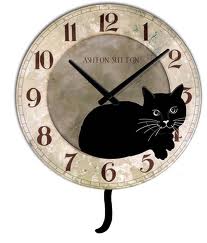
Here’s how it goes. Look at an old-fashioned (analog) clock
and note the twelve positions for the small hand. Fold a piece of paper in two,
then two again, and then in thirds. When you open the paper, you should have
twelve folds (or you can draw a circle and divide it into twelve parts.) Copy
the numbers from the clock onto your paper, with 12 at the top, one in the next
wedge to the right, and so forth.
Beginning at the one o-clock position, write in a letter G.
In the next wedge to the right, write in a letter D. Then continuing with the
Fat Cats jingle, continue lettering until you come to B at the five o-clock
position. Continue labeling the wedges with letters from the jingle, this time
adding “sharp” to the name. So at the six-o’clock position you will have
F-sharp, at the seven o’clock position, C-sharp, and so forth, through B-sharp
(Baloney) at the twelve o-clock position.
Translating: The key of G major (one o’clock) has one sharp.
The key of D major (two o’clock) has two sharps. Continuing clockwise or to the
right, you will reach seven sharps at C-sharp.
Since normal musicians try not to deal with more than seven
sharps, on the next key, we will spell the key enharmonically. Thus G-sharp
becomes A-flat, D-sharp becomes E-flat, A-sharp becomes B-flat, E-sharp becomes
F, and B-sharp becomes C at the twelve o’clock position.
You can back up and spell B, F-sharp and C-sharp
enharmonically as well. These three keys are commonly spelled one of the two
ways. Reading around the Circle to the left or counter-clockwise, the key of F
(enharmonically E-sharp, at the eleven o-clock position) has one flat. If you
continue to the left, saying your Fat Cats jingle backward, you’ll run into the
key of B (five sharps) or C-flat (seven flats), F-sharp with six flats, same
sound as G-flat with six flats, and C-sharp (seven sharps), same sounds as
D-flat with five flats. Now you have all the key signatures of the twelve keys
as well as the names of the sharps or flats used in their scales. Only the
three keys at the bottom of your circle, B, F-sharp and C-sharp are in common
use with either of their two names apiece.
If we were crazy enough to construct theoretical major
scales beyond C-sharp major with its seven sharps, G-sharp major would have
eight sharps. F would become a double-sharp (Fx) and the other sharps would
follow the jingle: C-G-D-A-E-B. Spelling the remaining meta-keys, double sharps
would be added in the exact order normal sharps were added. At the twelve
o-clock position in the meta-key of B-sharp major, we would have a key with
twelve sharps: Fx,Cx,Gx,Dx,Ax, E-sharp and B-sharp. Spelled enharmonically, of
course, it is a plain old C major scale, C,D,E,F,G,A,B,C.
The only flaw in the image is that when first labeling your
wedges, you must remember to start your jingle with a G (or “Go”), not F or C.
All this will be incomprehensible to non-musicians, who
might well ask why you need this information in the first place. Meredith
Wilson’s “The Music Man” has the band play “Minuet in G”. If you know about key
signatures, you’ll know what it means to play a minuet in G.