Monday, May 4, 2015

Unlikely Revolutionary

           
Coastside Community Orchestra's spring concert is Saturday, May 9, at Coastside Lutheran Church, 900 Cabrillo Highway, Half Moon Bay. The program includes music of Schubert, Bizet, Saint-Saëns and the unlikely revolutionary, Gioacchino Rossini.


             Gioacchino Rossini (1792-1868) Overture to The Barber of Seville (1816)

            Most people would be astonished at the idea that Figaro, the Barber of Seville, could have had any political influence away from the opera house. Equally surprising would be the suggestion that Rossini and Wolfgang Amadeus Mozart (1756-1791) were revolutionary in any way other than musically.
            Yet both Rossini’s opera “The Barber of Seville” and Mozart’s opera “The Marriage of Figaro” were based on plays of the same name by Pierre de Beaumarchais, plays which Napoleon called “the revolution in action”—because of their egalitarian treatment of servant and master.
            The French playwright de Beaumarchais supported the American Revolution and even personally arranged to ship arms from France for 25,000 American soldiers.
            “The Barber of Seville” was written in less than two weeks, Rossini’s normal time frame for his productions. The overture does not contain themes from the opera itself, possibly because Rossini had previously used it for three other operas, “Elisabetta”, “Aureliano” and “L’Equivicato Stravaganti”. “Barber” also used arias and ensembles from yet another Rossini work, “La Cambiale de Matrimonio,” written in 1810.
            From 1811 5o 1818, Rossini staged at least three operas a year. By 1829, he had written at least 39 such works.
            Although opera seems to have been mere business as usual for Rossini, his fellow musicians greatly admired his work. Schubert in particular was influenced by Rossini, and Beethoven admired his music.
            Rossini retired at age 37, a wealthy man, at the time of his greatest popularity. He never wrote another opera and in fact composed very little for the rest of his life—39 more years—though he continued to be honored throughout the western world as the grand old man of music.


Thursday, April 30, 2015

Why Was the "Unfinished" Unfinished?


I've been writing program notes for the Coastside Community Orchestra concert May 9, and thought it might be fun to post them in advance. Why Schubert's "Unfinished" Symphony, Number Seven or Number Eight, depending, remained unfinished is one of those music mysteries which has always invited speculation, and sometimes downright fiction. Here's my take on it. (The concert will be at 7 P.M. at Coastside Lutheran Church, 900 Cabrillo Highway, Half Moon Bay.)

Franz Schubert (1797-1828) Symphony in B Minor, D. 759 “Unfinished”
            Franz Schubert himself said that he was born for no other purpose than to make music. And make music he did, producing in his short life 19 string quartets, 21 piano sonatas, 600 songs, ten operas, seven masses, volumes of work for piano solo and piano duet, and nine or ten symphonies including the “Unfinished.”
            Harold Schonberg says in Lives of the Great Composers that Schubert “seemed content to pour out page after page of music, whether or not it was performed.” He left no estate—no property or progeny-- except for music manuscripts scattered all over Vienna. Robert Schumann discovered Schubert’s unplayed ninth symphony, the so-called “Great C Major” in a box left at a brother’s house, and Felix Mendelssohn conducted the world premiere of the work in 1839, eleven years after Schubert’s death.
            Schubert was the twelfth of 14 children and became a boy soprano in Vienna’s court chapel at the Imperial and Royal Academy, where he received his musical education. He never traveled far from Vienna. By the age of eleven, he was already a prolific composer. He may not have had quite the gravity of his contemporary, Beethoven, but no one could resist the singular beauty of his melodies and the startling innovations in his key-shifting harmonies. The house concerts—Schubertiades—arranged by his friends were famous.
            The original seventh symphony, in E major, was sketched out in 1821 and was never completed, so the B Minor work done in 1822 became Number Seven. Number nine, the symphony unearthed by Schumann, was written in the last year of Schubert’s life. Another symphony known as the Gmunden-Gastein (for two places Schubert had spent summer vacations) has been lost, though some elements may have been used in the Great C Major.
            Just why the Seventh remained unfinished has been the subject of much creative speculation. The symphony was dedicated to the Graz Musical Society which had just nominated Schubert, and in 1822 the composer left it in the hands of a member, who apparently laid it aside and never delivered it to the society. Since Schubert lived six years after that, composing all the while, chances are that he—and the friend—simply forgot about the symphony, or that the friend lost the last two movements.
            Schubert was a pallbearer at Beethoven’s funeral and died of typhoid a year later at the age of 31. He was buried beside Beethoven in what today is called Schubert Park, in Vienna.
            In 1894 Franz von Suppé (“Light Cavalry Overture,” “Poet and Peasant,”etc.) wrote an operetta, “Franz Schubert,” which one reviewer described as “wonderful biographical kitsch based on Schubert tunes,” and in 1916 another musical play loosely based on Schubert’s life had its premiere in Vienna, setting words to his famous melodies. Known as “Blossom Time” in the adaptation by Sigmund Romberg, the musical was wildly successful.
            Although classicists may have cringed at the popularized treatment of Schubert’s music, the operetta did in fact accomplish posthumously Schubert’s hopes of writing for the stage, and the play’s success was due almost entirely to the beauty of Schubert’s unforgettable melodies.
(Watercolor by Howard Gilligan, from Julius Schmid's 1897 painting of a Schubertiade.) 


Tuesday, June 24, 2014

Yesterday's Darling?


            Say you had a device which had been proven to make you smarter. It could teach little kids numbers and letters; it could teach big kids math and physics. Say it was made of organic material, had a shelf life of a hundred years, could work without batteries or electricity. Wouldn’t you want such a thing around, whether or not you could use it to play music?
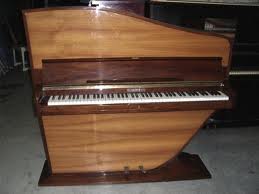
            Last year I was on the losing end of a much-publicized argument over so-called performance art which involved burning a perfectly good piano. This week I had two calls from people wanting to get rid of their pianos. “To a good home,” they said, as if pianos were kittens. The problem is that nobody seems to want the pianos, and nobody seems to know what to do with them. Some of them are turning up in landfill or being placed on the street for anybody to play.
            And people do play them. People come and listen to them play. But why aren’t they taking the pianos home?
            I know I have an extreme view. My grand piano in the small front room takes up the space some people might want for a proper sofa, a coffee table or a big-screen television. I am prejudiced in favor of pianos, which are so much more than musical instruments. I think every home and every classroom should have a piano, whether or not anyone plays or plans to play.
            Electric keyboards have their place—I have a couple and have given away a dozen-- but they are not pianos.  There are real pianos, and then there are mechanical pianos. If you have no choice, living in an apartment with thin walls or needing something portable, then the keyboards are something, though they need power, don’t blend with other instruments, and only sound like pianos if you are next door. A real piano changes with the weather. It is capable of nuance. It goes in and out of tune. It is a living thing.
            There was a time in Europe and America when everyone except the poorest of the poor could play at least a little piano music. Playing was considered a social grace; it made young women more marriageable and young men more attractive. Arthur Loesser in Men, Women and Pianos writes about the piano’s role in social history.
            But pianos are going begging any more. I have not been able to learn whether “Send a Piana to Havana”, a mission started by a Berkeley piano tuner, Ben Treuhaft, is still operating. Treuhaft arranged for unwanted pianos to be shipped to Cuba, which had more players than instruments. The documentary film “Buena Vista Social Club” underscores the Cuban passion for music and the need for instruments.
            My former student Lauren told me about  a national database for free pianos, http://www.pianoadoption.com/. Thousands of people are trying to get rid of their old pianos, and yet a new Steinway B will cost $110,990 next year, Mason and Hamlin pianos appreciate at 4.5 percent per year, and a new Bösendorfer will cost you $175,000 right now. I could almost swear to you that those pianos are being purchased by people who had some kind of piano around when they were little.
            I worry about people born around the turn of this century never achieving mastery in anything. The ones I know are smart enough, loyal, even passionate, but they can barely read and write (judging from Facebook) and  few of them can stay with anything voluntarily for more than a few minutes. Maybe they can bang out a few root-position chords on a Casio keyboard, but very few of them can play a Bach Invention.
            Video games and sports are not much comfort when times are tough, but music can always be your consolation through thick or thin, and the ability to plan an instrument will last a lifetime, as the neurologist and pianist Oliver Sachs has documented in Musicophilia and other books.
            Even if that old upright is gathering dust and making you feel guilty for not playing it, isn’t it an art object in itself? People staging houses for real estate sales often want to borrow a harp or piano for just that reason. The top of an upright is even better than a mantel for displaying photographs and family treasures and the rack can old an open album for display. Piano benches themselves are so useful that they disappear virtually on their own.
            If there’s a piano around, any toddler will try to play it, will make a personal voyage of discovery with those keys. Whether or not that toddler becomes a music prodigy, music will have a special meaning for him all his or her life. It’s not too late for you. Keep your piano. Sooner or later somebody will show up and play it. It might be wonderful. You might love it.


Saturday, February 9, 2013

Fat Cats and Meta-Music


Many years ago, Michael Marcus came up with a jingle for remembering the order of sharps in music: Fat Cats Go Down Alleys Eating Baloney. If a piece has one sharp, it will be F# (Fat); if two, then F# and C# (Fat Cats) and so forth. For the order of flats, one simply says the jingle backward: Baloney Eating Alleys Down Go Cats Fat or B-flat, E-flat, and so forth.

For reasons we don’t need to explore for now, nine of the twelve musical tones can be called by more than one name, disregarding double-sharps and double-flats. For instance, A-sharp (A#) is the same sound as B-flat. The name for this relationship is enharmonic spelling; same sound, different name.

All this is leading up to a marvelous image for memorizing musical key signatures, which tell us which notes are used in the twelve major and twelve minor scales of western tonal music. Most musicians know the Circle of Fifths, and you can’t get through freshman theory without memorizing your key signatures, but the image in question takes you into the area of meta-music. When I showed it to my piano duet partner, John Maxwell, he said “So there is order in the universe after all.”

 
Here’s how it goes. Look at an old-fashioned (analog) clock and note the twelve positions for the small hand. Fold a piece of paper in two, then two again, and then in thirds. When you open the paper, you should have twelve folds (or you can draw a circle and divide it into twelve parts.) Copy the numbers from the clock onto your paper, with 12 at the top, one in the next wedge to the right, and so forth.

Beginning at the one o-clock position, write in a letter G. In the next wedge to the right, write in a letter D. Then continuing with the Fat Cats jingle, continue lettering until you come to B at the five o-clock position. Continue labeling the wedges with letters from the jingle, this time adding “sharp” to the name. So at the six-o’clock position you will have F-sharp, at the seven o’clock position, C-sharp, and so forth, through B-sharp (Baloney) at the twelve o-clock position.

Translating: The key of G major (one o’clock) has one sharp. The key of D major (two o’clock) has two sharps. Continuing clockwise or to the right, you will reach seven sharps at C-sharp.

Since normal musicians try not to deal with more than seven sharps, on the next key, we will spell the key enharmonically. Thus G-sharp becomes A-flat, D-sharp becomes E-flat, A-sharp becomes B-flat, E-sharp becomes F, and B-sharp becomes C at the twelve o’clock position.

You can back up and spell B, F-sharp and C-sharp enharmonically as well. These three keys are commonly spelled one of the two ways. Reading around the Circle to the left or counter-clockwise, the key of F (enharmonically E-sharp, at the eleven o-clock position) has one flat. If you continue to the left, saying your Fat Cats jingle backward, you’ll run into the key of B (five sharps) or C-flat (seven flats), F-sharp with six flats, same sound as G-flat with six flats, and C-sharp (seven sharps), same sounds as D-flat with five flats. Now you have all the key signatures of the twelve keys as well as the names of the sharps or flats used in their scales. Only the three keys at the bottom of your circle, B, F-sharp and C-sharp are in common use with either of their two names apiece.

If we were crazy enough to construct theoretical major scales beyond C-sharp major with its seven sharps, G-sharp major would have eight sharps. F would become a double-sharp (Fx) and the other sharps would follow the jingle: C-G-D-A-E-B. Spelling the remaining meta-keys, double sharps would be added in the exact order normal sharps were added. At the twelve o-clock position in the meta-key of B-sharp major, we would have a key with twelve sharps: Fx,Cx,Gx,Dx,Ax, E-sharp and B-sharp. Spelled enharmonically, of course, it is a plain old C major scale, C,D,E,F,G,A,B,C.

The only flaw in the image is that when first labeling your wedges, you must remember to start your jingle with a G (or “Go”), not F or C.

All this will be incomprehensible to non-musicians, who might well ask why you need this information in the first place. Meredith Wilson’s “The Music Man” has the band play “Minuet in G”. If you know about key signatures, you’ll know what it means to play a minuet in G.

Thursday, December 13, 2012

Church Music


J.S. Bach got in trouble in the 1700s for showing an unchaperoned young lady the pipe organ in the choir loft. I didn’t get in trouble when a young church organist showed me the Allen organ in the choir loft Tuesday evening, but I did get a bit winded from climbing three flights of stairs.
            Nicodemus and I, finding ourselves without a Christmas gig for the first time in memory, volunteered to play for caroling at our church in San Francisco.
            Music at Holy Trinity Greek Orthodox is almost exclusively Byzantine chant, as it is in almost all Orthodox churches. A number of Russian composers have made beautiful settings of the liturgy’s 11th-century words, but church choirs find the music daunting and mostly stick to the ancient modal chants. Some Orthodox churches still use the primitive notation called neumes, music writing which looks a little like some kind of pasta.
            The choir accompanist is the only organist we hear at church, so I met the wedding organist for the first time when he came over while we were playing to see if there was a way to open up the little Rippen piano to get more sound (there wasn’t.)
            After the carols and the treats—you can imagine the spread a Greek church calls snacks--we got to talking about organs and the young man, George, said he had selected the instrumental sounds for the church’s organ, an Allen, when it was being built. Organists usually sound a little apologetic when they speak of electronic organs (as opposed to pipe organs,) though the serious electric ones have a wonderful sound and don’t depend on hard-to-find pipe repairmen.
            “Would you like to see it?” he asked.
            “Oh, yes,” I said. I have never been in the choir loft, which has its own beautiful mosaics of Saint Kassiani and other hymn composers.
            “Oh, it’s just like the one our local orchestra used for the Saint-Saëns organ concerto a little while back,” I said, still a little out of breath.
            “Oh, wow,” the organist said, and immediately launched into the famous theme on full organ with every pedal stop depressed, hands and feet moving happily, drowning out the taped chanting which goes on downstairs all the time and probably terrifying a few sleeping pigeons on the roof.
            “Oh, my goodness,” I said,  overwhelmed. Saint-Saëns was a universe—and ten centuries—away from the five-note Kyrie Eleisons we usually hear in church.
            “What does your trumpet sound like?” I asked.
            He whipped out a computer card, did some sleight-of-hand, and played the Jeremiah Clarke Trumpet Voluntary, full organ, pedals. I reached over his right hand and joined the fun up on the high notes.
             I got all the way home before I remembered that there’s a closed circuit TV camera on all the time at church so that people can look at their computers to see the mosaics and listen to the chanting if they need a quiet moment. I do it myself from time to time when I can’t sleep.
            If anybody was watching Tuesday evening, they wouldn’t have seen anything different, but they would have heard a lot of organ music which was anything but Byzantine.

Tuesday, May 1, 2012

The Music Mystique


 I have been searching in vain for a music theory book which would be good for a couple of bright young instrumentalists who want to know more about the architecture of music but who don't yet need college-level theory and harmony. The next several blogs are what resulted. We had to write our own book, the kids and I. It is called

The Music Mystique
Basic Music Theory


Did you know that musical rhythm is based on your own heartbeat and breathing rate? Or that the scale, the basic building block of music, is actually based on the physics of sound? Did you know that every human being has these musical elements built in, and that this fact can be proven? That some people believe the Big Bang which started the universe was actually a dissonant chord? That everything in creation from the atom to Jupiter vibrates and thus has a sound?
The Nineteenth Century composer Robert Schumann called music a bridge to the unknown. Music theory shows the construction of that bridge. Because it encompasses history, anthropology, physics, mathematics and languages, knowing something about music theory reinforces all these other fields. Understanding basic theory, you can learn the rudiments of reading music in less than an hour, can play three chords and a melody...all it takes for some folks to be country music performers or rock stars!           
There are hundreds of music theory books in print, many of them college-level books which include music history and advanced analysis. There is a Music Theory for Dummies which, despite its unfortunate title, may tell you more than you really wanted to know about music theory. The theory books which accompany instrumental method series mostly refer to applied theory.
You probably already know a lot of music theory intuitively, since you have been listening to music all your life. My primary goal in teaching music theory is to provide a vocabulary and to demonstrate the elegance of  the traditional customs which lie behind the music you know and love. This little book is intended for the music student who has played an instrument for several years and is interested in learning more about the order behind the music he or she is playing.
There are several good on-line sources for basic theory information: Music Theory Pro, an application for iPhone and iPad, lets you test yourself in various areas of theory. An invaluable web site, updated daily, which tells you everything you wanted to know about music theory is found at http://www.teoria.com/index.php.
The neuroscientist Daniel J. Levin is among those who have used magnetic imaging to show the positive way music affects the brain. In his book This Is Your Brain On Music, Levin says “By better understanding what music is and where it comes from,, we may be able to better understand our motives, fears, desires, memories, and even communication in the broadest sense.” The neurologist and music lover Oliver Sacks’ book Musicophilia says that all people are hard-wired to love music and that the ability to sing or play an instrument creates positive physical changes which last a lifetime.

Friday, February 10, 2012

Music Guilt


Do my old piano students hide when they see me coming down the street? I am convinced that they do. Why else would I live in a community of 30,000 and hardly ever see one of the thousands who have sat at my piano and said “I played it better at home”?

When I made my excuses for not practicing enough, my piano teacher would say “I’m so sorry” and then give me an unforgettable lesson on some aspect of my assignment which did not involve much playing on my part.

At some point in my 50-year teaching career, I got the idea of the graceful exit. I had already made myself the student’s ally in situations where clearly it was time for the lessons to end.

“Pleasing your parents is a legitimate reason to take some lessons, but I can see you aren’t enjoying it very much.”

“Would you like me to get you out of this?”

“We can still be friends. You can come to see me without having to play piano.”

“You have accomplished quite a lot during this time, so you should feel good about that rather than feeling bad that we’re stopping here.”

On one occasion, I presented a teen-ager who was quitting lessons with a certificate of accomplishment, a prize ribbon and pin, a list of her repertoire, and suggestions for pieces she might enjoy playing on her own. I never heard from her or saw her or her parents again, though they live in my neighborhood.

Piano teachers become attached to their students, and occasionally the attachment goes both ways. I am still in touch with a few of my former students. But for the most part, once they quit lessons, they are gone. I have only discontinued lessons a few times without being asked to do so by parents or students, once because of persistent rudeness and the other times because of persistent absenteeism. So I think I am dealing with music guilt most of the time.

Of course they should have practiced more, and so should I. I hate to think what my poor mother went through to get me to practice. The final incentive was the threat to end the lessons if I didn’t practice, and that one always got me to the piano. I am not a very good example when it comes to practice, but if I total up all the hours I have spent at the piano, it certainly would surpass the 10,000 hours the experts now say it takes to really learn a skill. (Notice that I do not say “master” a skill.)

I left my teacher only when he moved to a rest home which had no piano. At my last lesson, he couldn’t even remember my name, but he remembered that we were fond of each other, and he remembered all the page turns in the Chopin Scherzo I was studying. He got up from his chair across the room and turned the pages for me.

It is possible that my students’ lessons were not all that important to them, that they were just one more activity, that they were like a sixth grade English class or something, where you would go on your way and never feel the need to stay in touch. But piano lessons are one-to-one, not one-to-thirty. Piano teachers and their students know a lot about each other. They might still have something to say to each other even after the lessons are over.

(The Seal of Approval, above, appears on all my students' assignment sheets.)

Saturday, October 15, 2011

The X-Factor and American Idol


I have been watching a singing competition called X-Factor on television. This is not my kind of music (if indeed it is music at all), but I want to know what people are listening to, and the audience for this show has been estimated at some 12 million people.

The X-Factor supposedly was judge Simon Cowell’s nose-thumbing to the runaway success American Idol. The similarities between the two shows are more remarkable than the differences (Pepsi vs. Coke), and they do not compete against each other, since Idol does not resume until January, 2012. Thousands of youngish men and women, most of them delusional, audition from every part of the country. Each one whose face makes it to television says “This is my dream” and “I want this so much” and “I’ve been singing since I was three years old.” Often they cry and tell something sad about their life.

A few of these thousands are chosen and perform pop songs in front of four judges. Idol has an audience and a band; X-Factor does not, at least not yet, and it uses recorded accompaniments instead of live musicians, though there are grand pianos sitting around for atmosphere.

The top prize in X-Factor is five million dollars and a recording contract. One contestant, filmed on the grounds of a judge’s Malibu estate, said “If I win the five million dollars, I’m going to buy a house like this.” Beachfront Malibu property goes for sums in the forty millions, and this young man is not going to win because he doesn’t fit the image which appeals to the target audience.

Target audiences for recordings are age 14 to 24, for radio 15-30. The 40-year-old African-American with the stunning vocal ornaments may make it into the finals, but she will not win.

To win, here’s what you need: A commercially viable appearance and sound, the right combination of conformity and individuality. True, you should try to sing in tune, but more importantly, you should be cute and confident. People of color rarely win American Idol, nor do homosexuals (Adam should have won.) I have yet to see an Asian contestant, though I may have missed something; I can only stand so much.

Finalists do get some advertising work, and some Idol winners have gone on to have recording careers. I would like to think that the also-rans get royalties, but I’d be willing to bet that they signed away this right when they auditioned.

Idol/X Factor music is generally aimed at an audience older than the pre-teens who launched Spice Girls and Justin Bieber to fame. Some of the music, however, still fits the Wiki definition of Bubblegum, being “ pop music... produced in an assembly-line process, driven by producers, often using unknown singers...” “The songs typically have singalong choruses, seemingly childlike themes and a contrived innocence, occasionally combined with an undercurrent of sexual double entendre. Bubblegum songs are also defined as having a catchy melody, simple chords, simple harmonies, dancy (but not necessarily danceable) beats, repetitive riffs or “hooks”, use of solfege syllables and a vocally-multiplied refrain.”

I wish Coke and Pepsi would set up an education program for all these thousands of people who have been singing since they were three, or else contribute substantially to existing programs. I wish they would send lots of money to Gustavo Dudamel, the young conductor of the Los Angeles Philharmonic, who is launching a wonderful music education program similar to the one in which he studied in Venezuela. Gustavo has probably been singing since he was three, he’s cute, he’s smart, and by golly, he can even read music. He makes a base salary of a million and a quarter a year, recording contracts, I don’t know what all. Importantly, he will still be doing his job when nobody remembers American Idol or X-Factor.

Meanwhile, here is some advice for Idol/X-Factor contestants: If Simon mentions phrasing, try to find out what that means. Do not scream. Do not perform your original song, because it isn’t any good and nobody wants to hear it. “Make it your own” does not mean distorting the song beyond all recognition. Songs have composers. Please use the name of the composer rather than that of the performer when you say what you’re singing. If you have religious views, keep them to yourself. This is the Temple of Mammon, after all. Try to keep a vestige of dignity. Sing TO the judges, not AT them.

Sunday, May 15, 2011

Natural Music

We believe music came from nature, that the rhythms and melodies we love had their origins in the sounds around and within us. But sometimes the natural world seems to join in rather than initiate our music-making.

Animals who live in a musical house will usually vote one way or the other. More than one cat has taken a liking to Mozart or has left the room when the atonal music began. Old dogs which are becoming hard of hearing sometimes like to sleep under a grand piano, where they can hear the sound, but not too loudly.

Once Charles and I were playing a Shostakovich cello sonata at a senior residence facility. The first movement was whimsical and playful, but the middle movement was as stark and cold as I imagine a Russian winter--or being old-- might sometimes be. As we played, the wind whistled around the edges of the building like a third musician. The audience clearly welcomed the return to cheerfulness in the last movement, and so did we.

Once while I was playing the organ at church, I became aware of a small sound which started up as soon as I began playing and stopped when I stopped. It took a while to realize that the sound was coming from a frog which had parked itself in the doorway near the organ. He sang along for quite a long time.

Today at the Coastside Community Orchestra concert, there seemed to be a strange piccolo part in Schubert's incidental music from Rosamunde. It was a kind of counterpoint, and, for goodness' sake, it was coming from outside the window. It was a songbird who apparently liked Schubert.

Monday, January 24, 2011

The Times Critic's Top Ten

Anthony Tommasini, music critic for the New York Times, published his picks for the top ten composers (excluding living composers) of all times.
1. Bach
2. Beethoven
3. Mozart
4. Schubert
5. Debussy
6. Stravinsky
7. Brahms
8. Verdi
9. Wagner
10. Bartok

But where is Haydn? Handel? Dvorak? I'm afraid the last three--maybe even the last four--wouldn't have made my list.

Friday, January 14, 2011

Some Constellation

“Classical” music, strictly speaking, is music written between 1750, the date of J.S. Bach’s death, and the end of the eighteenth century, when Beethoven walked through the front door of the palace and ushered in the Romantic period of music.

Bue “classical” has become a catch-all term for music which doesn’t easily fall into other categories. People have tried calling it art music, un-popular music, longhair. It’s a bit like the word “germ” for a doctor, who will want to know what kind of germ we are talking about. Or “baby grand” for any horizontal piano measuring five to nine feet from tail to keyboard, each piano having a particular descriptive name, none of them including the word “baby”.

The Classical or Rococo period. Mozart, Haydn, Clementi. Geniuses all, and treated as glorified domestic servants in livery under the fickle patronage of various noblemen. Yet music was their day job. They didn’t have to teach, doctor or sell insurance.

Instead, they invented the symphony (Haydn), produced deathless diamonds of melody which would support generations of musicians and transport their audiences (Mozart), write a music method book which would teach geniuses such as Chopin and Debussy (Clementi’s Gradus ad Parnassum or Steps to Parnassus).

My Keyboard Literature teacher, Sylvia Jenkins, said that the Classic view of God was that of a divine clock-maker, that God wound up the universe and let it run all on its own. Accordingly, people of the late 18th Century loved music boxes and clockwork toys. Musicians including Mozart wrote pieces for wind-up players. This concept of God and music was different from that of Bach, who believed that all music came directly from heaven, or from that of Chopin, who believed that music was a purely human creation.

The musicians I call musicians mostly started their job training as children. By the time they were adults, they had logged thousands of hours of practice time, which meant they were probably not good at sports. They can count beats and rests, can play in more than one key, can transpose without electronic assistance. They understand Italian musical terms and know the difference between a da capo and a dal signo.

Most of them have to teach whether or not they are good at it, just to pay their bills. The orchestra players have to play in several orchestras. The singers spend their lives auditioning and looking for an accompanist. The lucky few get studio jobs, shows and casuals (parties, weddings) to keep body and soul together.

And yet being a “classical” musician is a rare privilege and a constant consolation. As my piano duet partner John says, “It is some constellation.”

Wednesday, October 13, 2010

Titans in Warsaw


An international Chopin piano competition is taking place in Warsaw, Poland, and performances are streaming live on the Internet. There is a nine-hour time difference, so much of the playing is in the middle of the night for me; still, I have seen almost all the archive tapes and many of the recitals.

The preliminary round had 346 players, winnowed to 80 in the first cut and then to 40 on the second day, where each musician presented a 20-minute program for a distinguished jury and a packed house (the audience doesn't even cough except between selections.) Pianists choose from four pianos, a Steinway, a Kawai, a Yamaha, or a Fazioli, the most expensive piano in the world, with a top model costing $400,000. Most choose the Steinway. The top prize for the contest is 30,000 Euros, but each of the ten finalists will get a substantial reward.

I would not like to be on the jury for this competition, though the jurors and I agreed on about half of the semi-finalists. Every candidate is technically flawless; the programs are performed from memory and one hardly ever hears a note error. One thing the jury is listening for is a certain Chopinesque style, especially in the Mazurkas and Polonaises. But the defining requirement is that the listener be moved by the performance.

The tools for executing a moving performance are limited: Beyond the notes, rhythms, tempi and dynamics the composer specifies, the player needs to define the importance of the various elements of the composition. When the composer indicates piano or soft in a place having several notes playing simultaneously, he is specifying an over-all volume. Not all the notes have the same value, nor do all the musical lines and phrases. These are details the artist must decide upon, and the memorable performances are like stories, with a beginning, a development and an ending, high points and interludes. The player who only plays the notes will be accused, as was one contestant, of "sounding like the recording", even though he did nothing particularly wrong.

This is some of the best Chopin playing I have heard anywhere, any time. Almost all the pianists have something to say with their music, but the players I have loved the most were the ones who made me feel I had never heard the pieces in quite the same way before. Nicodemus and I agree on most musical things, and he said it better than I could: In the most profound musical experience, a spiritual truth is revealed.

Of course, mastery of the instrument is a prerequisite.

Because all the finalists obviously could not be Russian, only six of the extraordinary Russian players advanced to the semifinals, cutting two of my favorites. There are three Americans, two players each from Italy, China, Poland and France, and one each from Bulgaria, Austria and Australia. The semifinalists include 13 men and seven women. None of the 15 Japanese players, four Koreans, three Israelis, the Canadian, Croatian, German, Swiss, Armenian or Spanish pianists made it to the list of twenty.


Monday, October 4, 2010

The Page Turner


I wasn't even playing; I was just turning pages for Bob, the extraordinary pianist of the Trio Cabrillo. It was a long program, an hour and three-quarters, not counting intermission. Lots of it went so fast it was all I could do to keep up. I was so pumped up, it took hours to get to sleep that night.

You learn a lot about a pianist when you turn pages. Most of this I already knew about Bob, having turned for him several times, but I want to note these traits of his for the benefit of pianists who welcome performance tips.

1. He cares more about the work he is playing than about himself, the person playing it.
2. He is even-tempered, which makes people like working with him.
3. He has done his homework. He knows the music.
4. If he makes a mistake, he doesn't let it throw him.
5. He is not afraid of making a mistake. He doesn't make excuses.
6. He is willing to take risks.
7. When he plays, you feel that he wants every note; every phrase is beautiful.
8. He doesn't complain about the piano, even when to the observer the piano seems less than grateful.
9. He doesn't complain about the page turner, even when she doesn't notice the repeat sign.

(Photo is Bob playing the Saint-Saëns piano concerto with the Coastside Community Orchestra)

Monday, September 20, 2010

Playing Poorly

Well, sometimes we just don't play as well as we'd like to.
That was the case when I massacred Rodgers and Hammerstein's Carousel Waltz at the Coastside Chorale's concert last June. I knew it was bad, but didn't know how bad until I tried to listen to the CD a few days ago.

The accompaniments to the rest of the program are probably all right, but it was the solo performance which was, frankly, awful.

My teacher always had the same answer for times like this: "Take your lumps".

Nonda reassured me: "I have lots of CDs like that. Just put it in a drawer somewhere and don't listen to it."

Aargh.

Thursday, September 9, 2010

Piano Dreams

My usual piano dreams run something like this: I am supposed to play for a wedding, but I can't find the church, am late, arrive without my music books, desperately try to think what I can play without sheet music.

I have ruined instrument dreams. Usually it is a school, where someone has left beautiful pianos, harpsichords and clavichords out in the rain. Sometimes it is a church (Episcopal, strangely, though I have only rarely played for Episcopal churches) meeting in a basement with a ruined organ.

Last night's dream was different. I was back at Skyline College, late to class, didn't have my books, couldn't find the room...and when I found it, there were a dozen people sitting on the floor, waiting to be taught, but no pianos.

So at the dream-Skyline, I had all the students sign a paper, lacking a proper roll sheet, and began the lecture. "We are going to talk about seeing today. We are going to talk about description. No matter what you choose to communicate, whether by written word, spoken word or music, the clarity of your vision is essential."

Casting about for something to use as a model, I picked up an instrument from a pile of discards in the corner of the room. A banjo. As the dream ended (and my real-life cat decided it was time to rise and shine) there was one lone plunk from the banjo strings: A lecture coda.

Friday, July 9, 2010

Clef Signs and Piano Duets


To the non-musician, the treble clef sign is just an icon representing music; the bass clef sign is a mystery, and the other clef signs are nothing but hieroglyphics. To the musician, however, the clef signs are fixed stars. They show the unchanging location on the lines or spaces of a particular music note, and just as you can find your way by knowing East, all the other notes may be found from the one.

The treble clef sign shows the G above middle C and the bass clef sign shows, between its dots, the fixed location of the F below middle C. The less familiar clef signs fix the location of middle C and are used by cellists, violists, trombone players and others who spend lots of time in that desert between the top line of the bass clef and the bottom line of the treble. Tenors in choirs use a treble clef which sometimes has a little figure eight at the bottom, since their notes are sung or played an octave lower than written.

“Treble” means high and “Bass” means low. Most pianists are used to having the right hand on the higher notes and the left on the bottom. We never take the clef signs for granted, however, since both hands could play in either treble or bass.

In the wonderful world of piano duets, it is common practice for primo or prima (the high part) to play using two treble clefs, with secondo or seconda playing two bass clefs, both hands on the bottom part of the piano.

In the old days, before phonographs and radio, piano duets were often the only way people could hear the latest orchestral or chamber music works when they lived far away from cities which had orchestras (almost everybody had a piano and many people could play a little.) Four hands would split the parts of the instruments between them. Even Brahms, during whose lifetime recording was invented, provided four-hands versions of some of his works.

In the 19th Century days, a courting couple might be left unchaperoned if the lady’s female companion could hear the piano from her post outside the salon door. A few three-hand piano pieces date from this time.

Scrambling the clef signs produces a different kind of recreation for the player with no discernible difference in the sound. Chopin, Schumann and others would sometimes write a bass clef note higher than the treble note played at the same time. The effect is that the player’s thumbs cross, a kind of “Hello” from the composer, since the listener can’t tell from the sound that this is happening.

Mozart at least once wrote duets so that one player was still holding a key down when the other player landed on it. Mozart’s duets were probably played with his sister Nannerl, so he managed in this way to give her finger a good poke.

Other composers including Schubert and Brahms arrange the clefs so that the duet player’s arms cross. Great examples of this are the last part of Schubert’s piano duet piece called “Our Friendship Never Changes” (“Notre amitie est invariable”) and the fourth Brahms Hungarian Dance which John and I are playing in the video.

Duet references: Cameron McGraw, Piano Duet Repertoire, Indiana University Press. Ernest Lubin, The Piano Duet, Grossman.


Wednesday, July 7, 2010

Tears and Moonlight


When I first encountered Beethoven’s Sonata Op. 27, No. 2, quasi una Fantasia—famously known as the “Moonlight”—I was heartened by the fact that I could play the first few bars and that they sounded like something. Never mind that the beginning of the Adagio sostenuto is just a single repeated broken chord; I was a teenager and sincerely wanted to express drama, misery, mystery. Not to mention seeming to be a better piano player than I really was.

Mrs. Pack, my teacher, coolly informed me that the sonata had three movements and that I might want to get acquainted with the other two. Undaunted, I practiced the Adagio—the easy movement--for hours (or at least half-hours) on end and achieved my goal when I played it for my friend Audrey and she cried.

Since that time, I have probably taught the slow movement of the “Moonlight” several hundred times, the middle movement two or three times, and the third movement not even once. “Try to remember that it is their first encounter with this music,” Mr. Sheldon reminded me when I complained about always having to teach Beethoven’s “Für Elise”, Mozart’s C Major, the “Moonlight” and Debussy’s Clair de Lune. “Remember how you felt when you first heard it.”

There is power in the Adagio of Beethoven’s Op. 27, No. 2. How else can I explain the lengths to which some students will go to try to play it? One student, barely in Level Two, taught himself the first page using diagrams of the keyboard with the hands drawn in.

Terry, whom I encountered at the grocery store yesterday, lettered every single note of the Adagio and triumphantly played the last chord after three months of diligent practice. He refused, however, to play it in the annual student recital. The piece was already on the printed program, so I announced that I would play it in Terry’s place.

As I played, I noticed stirring and tittering from the audience at the Bach Dancing and Dynamite Society, the seaside concert hall where we used to hold our recitals. I was well into the Adagio when I saw the reason.

Terry’s wife, Cynthia, had cut out a cardboard moon and, using a rod and reel, was lowering the moon on a line from the balcony until it swung right over the big Steinway.

Wednesday, May 5, 2010

Grace Under Pressure

Quinn needed to make an audition tape for music camp, but we ran into technical problems. After trying three different ways to videotape his Handel, we finally succeeded in getting a recording on his cell phone. Mimi the cat, however, wanted to get in on the act.

In the video, you can see her pacing back and forth. Then you can hear me slap the piano book back on the rack after she knocked it askew by rubbing her face on it. Finally, she decided to help me play the piano.

There was no help for it; the deadline was on him and Quinn (who never stopped playing during all these shenanigans) submitted the cat-assisted tape. Not only was he accepted by the camp, but he won one of the Coastside Community Orchestra's music scholarships and will be playing with the first violins in this Saturday's concert.

Tuesday, April 20, 2010

High Drama in the Pit


The things you worry about in performing are the things you can’t practice or predict. Pianists often do not know the quirks of the instrument on which they will be playing; when accompanying, one never knows what the other performer might do or not do. When playing outdoors, keyboard players know to assure their power source, take lots of clothespins, minimize the page turns. All these reminders have been learned the hard way.

The wedding for which I most wanted to play beautifully, my niece and namesake Mikie’s marriage to Mark Newton, took place last week in an apple orchard in Napa, in gale-force winds.

Charles and I had prepared our favorite cello and piano pieces, had packed the instruments, stands, books. A few days before the wedding, the father of the bride, my musician brother Les, said that his friend the trumpet player would be able to make it after all, and would I mind playing the Clarke with him for the processional. Unfortunately, there would be no opportunity to practice, so we would just have to talk it through beforehand.

Which we did, scant minutes before we had to play. “It’s the ‘Trumpet Voluntary’, right?” “You’re playing it in D?” “Do you take the trills from the upper auxiliary or the principal?” “Which repeats do you want to do?” “And, by the way, why don’t we do the Jeremiah Clarke ‘Trumpet Tune’ for the first part of the recessional?” “How does it go again? Oh, yeah. Got it.”

So out in the apple orchard, everything set up and clips in place, my aunt’s old faux fur covering my pretty wedding dress, the music stand blew over and cut my hand, which began to bleed. The cello music was scattered everywhere. I adjusted the keyboard so that the wind would be blowing from the side instead of the back. I asked my son Ed to hold the books down; Charles changed music stands to one which had less wind resistance and held his scores with his bow until he could get the clips on. When he picked up the cello again, it had gone completely out of tune in the cold.

Miraculously, the sun came out as soon as we began to play.

Between Larry, the trumpet player, and Ed, both reading music upside-down and sideways, the books more or less stayed in place for the seating music, lovely Barber and Bach.

All went well except that we had to play the Brahms “My Thoughts Like Haunting Music” instead of the Bach Air on the G String for the first part of the processional, since that’s what we had clipped down to the stands and there was no way to change all the clothespins in time. Brahms is never easy, especially under pressure, and I was paying really fierce attention to the page.

The little flower girls walked very slowly, adorably, scattering petals and investigating the bottoms of their flower baskets. The Brahms finished before they reached their destination, and I did a quick take on what key to modulate to before the Trumpet Voluntary. OK, C to A; no problem. Thank God for harmony classes. Later, I asked my brother Les if he liked the special piece I composed for part of the processional, “Noodling in A Major.”

Larry picked up his trumpet for the second part of the processional as someone signaled that the bride was ready to come down the aisle. “I’m freezing,” he said, putting his lips to the cold brass instrument. I can only guess at what accommodation a brass player must make for an instrument which has grown as cold as that trumpet must have been.

The wedding was brief and beautiful. Larry played the recessional and then Charles and I played Elgar’s “Chanson de Matin”. By the time we finished, all the guests and the wedding party had bundled up and were walking toward the Carneros Inn, where the dinner and reception were to be held.

Everyone said the wedding music was beautiful and nobody had the least idea that we had been fighting for every note.

Sunday, March 28, 2010

Lesson Eleven: Fascinating Rhythm


Pianists often think of musical rhythm as a chore, or something they’re not good at. I managed to fake my way through years of piano lessons without my teacher’s ever realizing that I was simply imitating her playing, playing according to how the notes lined up on the page, or guessing. Freshman musicianship and Hindemith’s Elementary Training for Musicians put an end to the guesswork.

Everyone who has a pulse has a sense of rhythm, but at some point an aspiring pianist needs to figure out the code. Simply reading the ups and downs of a melody is simplicity itself, but the way rhythms are written hardly ever indicates how long the notes and rests last. Besides, musical rhythm is physical, not mental.

The good news is that once you memorize the symbols, whole, half, quarter, eighth and sixteenth notes and rests, you do begin to see the beats march across the page and do not have to count all the time.

You can practice rhythm anywhere, walking, tapping, analyzing. When you hear music, try to figure whether it is organized in measures of two, three, four, or something else. Taking your own pulse, count aloud in groups of three and then four. The pulse does not have an accented beat the way music does.

Drumming is a good way to separate musical rhythm from melody and harmony so that you can concentrate on the rhythm. It’s also lots of fun. I have sometimes been impressed into service in the Coastside Community Orchestra’s percussion section and have had to have telephone lessons from my drummer son, Nonda.

Whacking the daylights out of a bass drum is strangely satisfying, with the reverberations traveling up your arm and throughout your body.

(Percussion instruments made by Nonda: pandero, guero, rain stick.)